 |
|---|
Source: Research Intelo
As climate pressures intensify and global food demand rises, agriculture is undergoing a profound transformation. Remote sensing technology is emerging at the heart of this shift, offering unprecedented visibility into crop health, soil conditions, and environmental stress. The global market for remote sensing in agriculture is expanding rapidly, with increasing adoption across farms of all sizes.
• According to Research Intelo, the global remote sensing agriculture market • was valued at USD 2.8 billion in 2024 and is projected to reach USD 10.6 billion by 2033, expanding at a CAGR of 15.7%.
What Is Driving Adoption in Agriculture?
Several factors are fueling market growth:
1. Innovation and Automation:
The convergence of high-resolution satellite imagery, UAV/drone platforms, and ground-based sensors has revolutionized crop monitoring. AI-driven analytics and machine learning enable real-time interpretation of vast datasets, supporting predictive modeling and precision interventions. Affordable, scalable sensor technologies and interoperable software ecosystems are simplifying integration into farm management systems, reducing costs, and improving yields.
2. Precision Agriculture:
Continuous monitoring and data-backed insights are helping agribusinesses optimize inputs and improve productivity. Remote sensing facilitates targeted interventions, enabling more efficient fertilizer, pesticide, and water usage.
3. Sustainable and Resource Efficiency:
Increasing consumer demand for traceable, safe, and environmentally responsible food production is driving adoption. Early disease detection, optimized irrigation, and accurate yield mapping are central to sustainable farming practices.
4. Government Initiatives:
Many governments are promoting digital agriculture through subsidies, grants, and policy frameworks. Programs like the European Union’s Common Agricultural Policy (CAP) and public-private partnerships are supporting farmers in adopting advanced sensing technologies, particularly in developing regions.
What Technologies Are Leading the Market?
Remote sensing in agriculture relies on a combination of platforms:
• Satellite-based sensing: Offers large-area coverage with optical, radar, and thermal sensors for crop and soil analysis.
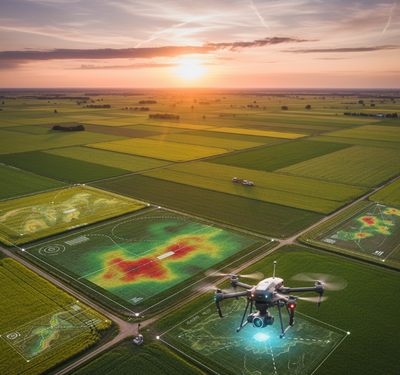
• UAVs/Drone-based imaging: Provides high-resolution, field-specific imagery for crop monitoring, soil analysis, and yield estimation.
• Ground-based sensors: Installed on tractors, irrigation systems, or fixed stations, these provide real-time data on soil moisture, nutrients, and crop conditions, particularly valuable for small and medium-sized farms.
Advanced analytics and AI platforms translate these data sources into actionable intelligence, enabling precision agriculture at scale.
How Is the Market Expected to Grow?
The market is projected to expand steadily over the next decade. Adoption is highest among large-scale farming operations in North America and Europe due to advanced infrastructure. Meanwhile, Asia-Pacific is experiencing accelerated growth, driven by extensive agricultural bases and government modernization programs. Increasing integration of AI models into farm management systems is further supporting market expansion.
What Challenges Could Slow Down Market Expansion?
Despite strong potential, several challenges remain:
• Regulatory uncertainty, particularly around UAV operations and data privacy
• Volatility in raw material and component prices due to global supply chain disruptions
• Lack of standardized data formats and interoperability protocols, which complicates integration with farm management systems
Addressing these challenges will require coordinated efforts from industry stakeholders, policymakers, and research communities to establish standards, streamline regulations, and build resilient supply chains.
What Lies Ahead for the Industry?
The future of remote sensing in agriculture is likely to revolve around integrated ecosystems. Satellite imagery, drone data, IoT sensors, and advanced analytics are expected to converge into unified platforms, enabling automated, sensor-driven decision-making. Such systems can optimize resources, enhance productivity, and strengthen climate resilience, ushering in a new era of data-driven, sustainable farming.
Source: https://researchintelo.com/report/remote-sensing-agriculture-market