What Higher Prices Mean for Your Policy, and Why Your Production Report Still Matters
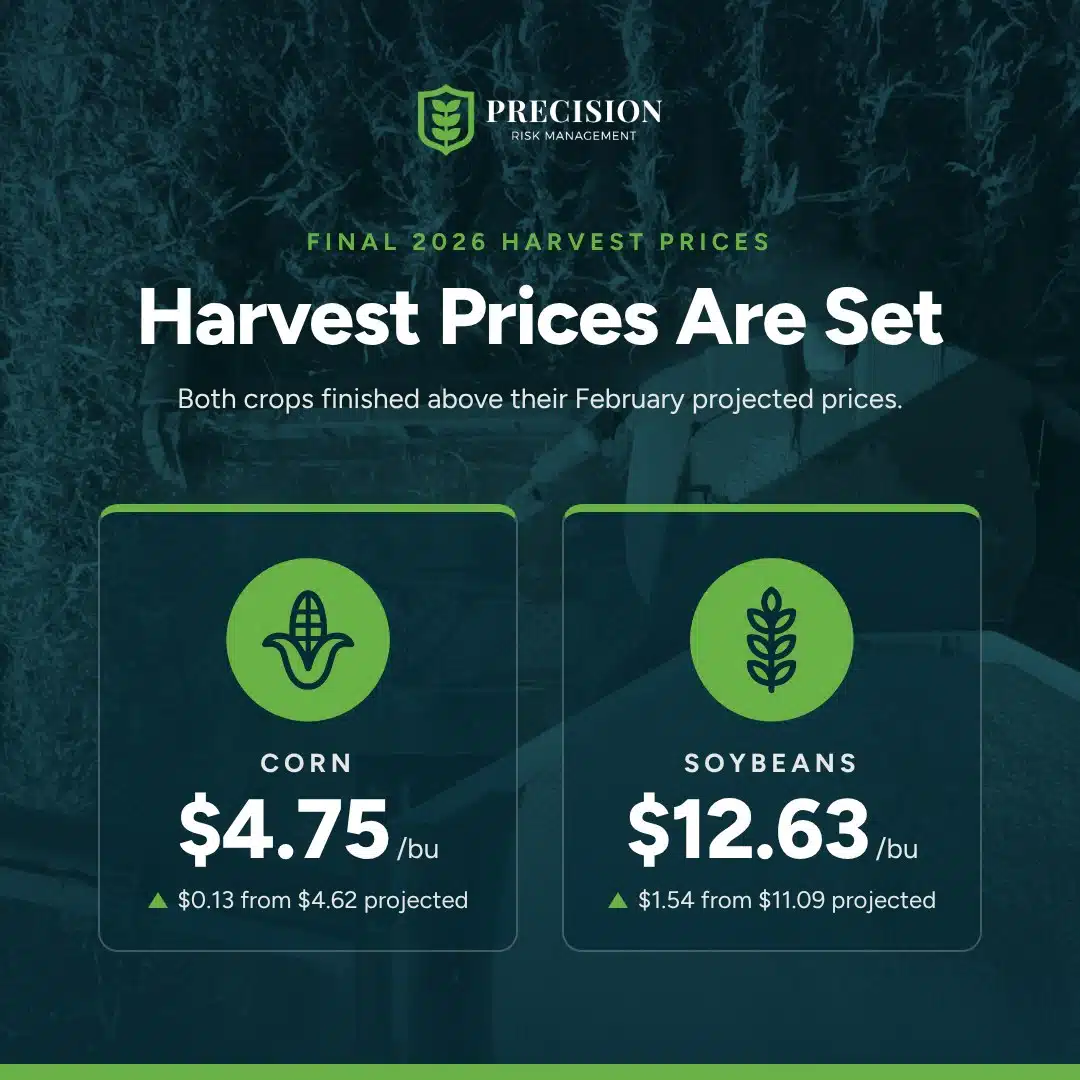
The 2026 harvest price discovery period for corn and soybeans has closed, and prices finished above where they started the year.
These harvest prices are now the final piece of the revenue calculation for 2026 corn and soybean policies. Below, we explain what they mean for your coverage, why a higher price doesn’t automatically rule out a claim, and what you can do now to speed up any payment you may be owed.
Projected Price vs. Harvest Price
Every Revenue Protection (RP) policy uses two prices:
- Projected price: Set in February from the average of the December corn and November soybean futures contracts. This price set your starting revenue guarantee when you bought coverage.
- Harvest price: Set in October from the average of those same futures contracts. This price is used to value the crop you actually harvested, and it can also raise your guarantee.
| Crop | Projected Price (Feb.) | Harvest Price (Oct.) | Change |
|---|---|---|---|
| Corn | $4.62 | $4.75 | +$0.13 (+3%) |
| Soybeans | $11.09 | $12.63 | +$1.54 (+14%) |
Prices shown are for states with a March 15 sales closing date, which includes most of PRM’s corn and soybean customers. Your PRM agent can confirm the prices that apply to your policy.
What This Means for Your Policy
With Revenue Protection, your guarantee is based on the higher of the projected price or the harvest price. Because both corn and soybeans finished higher in October, your revenue guarantee has increased.
Here’s how the guarantee is built. Your Actual Production History (APH) yield is your average yield, based on your farm’s past production records.
A higher guarantee is good news. It means every bushel you’re insured for is now worth more on paper than it was when you signed up in the spring.
Higher Prices Don’t Rule Out a Loss
It’s easy to assume that strong prices mean no claim this year. That isn’t always the case.
Revenue Protection compares two numbers:
- Your revenue guarantee (what you’re insured for)
- Your revenue to count (your actual harvested bushels × the harvest price)
When the harvest price is higher than the projected price, both sides of that comparison use the same harvest price. The price cancels out, and the question comes down to bushels.
How the Math Works: A Simple Example
Here’s a simplified look at a 100-acre field of corn and a 100-acre field of soybeans, each insured with Revenue Protection at the 80% coverage level.
| Step | Corn (100 acres) | Soybeans (100 acres) |
|---|---|---|
| APH (expected) yield | 200 bu/acre | 55 bu/acre |
| Coverage level | 80% | 80% |
| Guaranteed bushels (acres × APH × coverage) | 16,000 bu | 4,400 bu |
| Price used for the guarantee (the higher price) | $4.75 | $12.63 |
| Revenue guarantee (guaranteed bushels × price) | $76,000 | $55,572 |
| Actual harvested production | 14,500 bu (145 bu/acre) | 3,800 bu (38 bu/acre) |
| Harvest price | $4.75 | $12.63 |
| Revenue to count (harvested bushels × harvest price) | $68,875 | $47,994 |
| Indemnity (guarantee minus revenue to count) | $7,125 | $7,578 |
What happened here? The corn field came in 1,500 bushels short of its 16,000-bushel guarantee, so the loss is 1,500 bu × $4.75 = $7,125, or $71.25 per acre. The soybean field came in 600 bushels short of its 4,400-bushel guarantee, so the loss is 600 bu × $12.63 = $7,578, or $75.78 per acre.
What if yields were good? If that same corn field had averaged 170 bushels per acre (17,000 bushels), its revenue to count would be $80,750, which is above the $76,000 guarantee. No loss would be triggered.
The higher harvest price also made a difference. Had the corn guarantee stayed at the $4.62 projected price, it would have been $73,920. The October price increase added $2,080 of protection on this 100-acre field.
This is a simplified example for illustration only. Actual results depend on your APH yield, coverage level, unit structure, quality adjustments, and other policy terms. Talk to your PRM agent for numbers specific to your operation.
A Few Exceptions to Know
Claim Reminders: Turn In Your Production Report Now
The single most helpful thing you can do right now is get your 2026 production records to your PRM agent as soon as possible. Here’s why:
What to Have Ready
- Precision data from harvest
- Settlement sheets, scale tickets, and elevator or processor receipts
- Bin measurements for grain still in storage
- Feed or livestock records for any production used on the farm
- Yields broken out by unit, with production from different units kept separate
Talk to Your PRM Agent
Your PRM agent can review your 2026 production, walk through how this year’s harvest prices apply to your policy, and help you file a claim if you’re eligible. If you’ve already finished harvest, there’s no reason to wait.
Bottom Line
Corn and soybean harvest prices finished higher than they started, which raised the revenue guarantee on Revenue Protection policies. But a higher price doesn’t mean there’s no loss. If your yields came up short of your guaranteed bushels, you may still have a claim. Turn in your production records to your PRM agent today so you know where you stand and can get any payment you’re owed as quickly as possible.