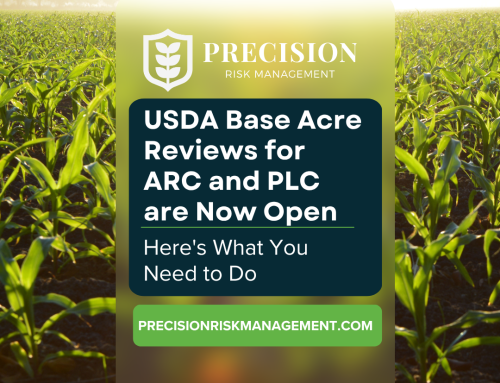

Every year, producers with base acres face a critical decision between choosing between ARC and PLC. But this year the choice is being delayed later into the year. Combined with the One Big Beautiful Bill Act making the most significant changes to these programs in years, it can be confusing for growers.
This guide breaks down what you need to know for your Spring crop insurance decisions.
2026 CHANGES
Sign-Up Timing
The USDA announced Farm Program selection will be delayed for 2026. Selection in previous years had a deadline of April 15. FSA offices say it likely won’t be until the fall of 2026 for sign-up.
You Must Make a Selection
For the 2025 crop year only, farmers automatically received the higher payment between ARC and PLC without making an election. For the 2026 crop year, farmers will be required to make an active election between the two programs.
One Big Beautiful Bill Changes (OBBBA)
The OBBBA made major updates to ARC and PLC, extending through 2031. Here are the changes that matter most for your 2026 decision:

Higher reference prices mean PLC triggers at higher levels. A stronger ARC guarantee (90% vs. 86%) means payments kick in sooner, and the higher cap (12% vs. 10%) means larger potential payments.
BASE ACRES CHANGE
The OBBBA authorizes up to 30 million new commodity base acres starting in 2026. This is the first base acre update in over a decade. Farms that have been producing covered commodities but lacked base acres may now become eligible for ARC or PLC payments.
What are Base Acres?
Base acres are the historical record of land on a specific farm that is tied to federal farm program payments. Instead of paying farmers based on what they actually plant in a given year, the government uses base acres to determine eligibility and payment amounts for programs like ARC and PLC.
Tied to the Farm, Not the Farmer
Base acres are assigned to a specific Farm Service Agency (FSA) farm number and remain with that land.
One Big Beautiful Bill Changes
Since 2018, base acres have been essentially locked. Because of this, many farmers who had been actively producing program crops did not have base acres assigned to their land, making them ineligible for ARC or PLC benefits. USDA will now allocate up to 30 million new base acres. FSA has indicated acre allocation will be completed before ARC/PLC sign-up begins.
Eligibility
A farm qualifies if: (1) at least one covered commodity was planted or prevented from planting in at least one year during 2019–2023, and (2) total planted and considered planted (P&CP) acres exceed current base acres as of September 30, 2024.
Automatically Added
Acres are added automatically unless the owner opts out. Farmers who haven’t reported plantings to FSA before can report to become eligible. If national demand exceeds 30 million acres, a pro-rated reduction applies.
Your Next Steps
- Check your base acres with your local FSA office.
- Talk to your crop insurance agent about layering SCO with ARC or PLC.
- Stay connected with PRM for election date announcements and updates.
- Make ARC/PLC election later in the year, once announced.
ARC and PLC PROGRAM BASICS
Agriculture Risk Coverage (ARC)
ARC provides payments when crop revenue declines below a specified guaranteed level. ARC is designed to protect against revenue losses caused by price drops, yield declines, or a combination of both.
There are two coverage options under ARC:
ARC-County (ARC-CO): This option triggers a payment when the actual county crop revenue for a covered commodity falls below the ARC-CO guarantee for that crop. The revenue calculations are based on county-level yield data and national market year average (MYA) prices. Payments are on 85% of the farm’s base acres for the covered commodity.
ARC-Individual (ARC-IC): This is a whole-farm option that triggers a payment when the actual individual crop revenue across all covered commodities planted on the farm falls below the ARC-IC guarantee. ARC-IC uses the producer’s yields rather than county yields, and payments are dependent on the actual planting of the commodities. ARC-IC payments are on 65% of the farm’s total base acres.
Price Loss Coverage (PLC)
PLC protects you when national commodity prices drop below a set floor called the effective reference price. It focuses purely on price. When the Market Year Average (MYA) price falls below the effective reference price, you receive a payment on 85% of your base acres. The maximum payment rate equals the effective reference price minus the national loan rate. 2026 national loan rates have not been released yet.
© 2026, Precision Risk Management. All Rights Reserved. Any use of these materials without authorization is prohibited. PRM is an equal opportunity provider. Not all coverage or products may be available in all jurisdictions. The description of coverage in this document is for informational purposes only. Actual coverage will vary based on the terms and conditions of the policy issued. The information described herein does not amend, or otherwise affect, the terms and conditions of any insurance policy issued by Clear Blue Insurance Company.