2026 Projected Prices Finalized
The Price Discovery Period for 2026 crop insurance for many crops has officially wrapped up, and the projected prices are now set. Combined with significant federal premium support, these prices mean that 2026 is shaping up to be one of the most affordable years for crop insurance coverage.
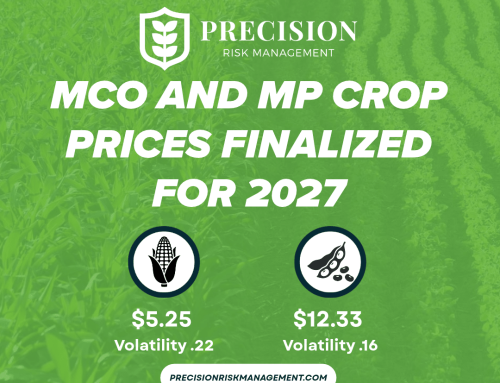
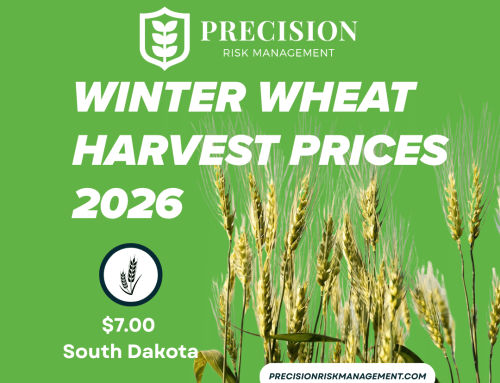
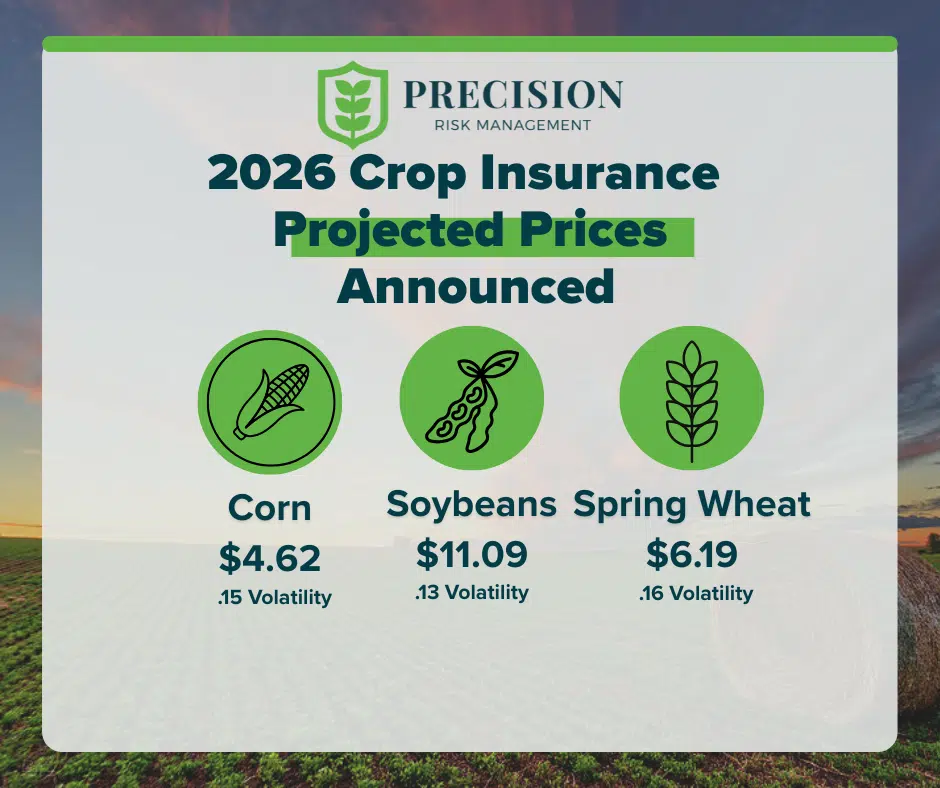
Here are the finalized projected prices and volatility factors for 2026, determined in the Price Discovery Period:

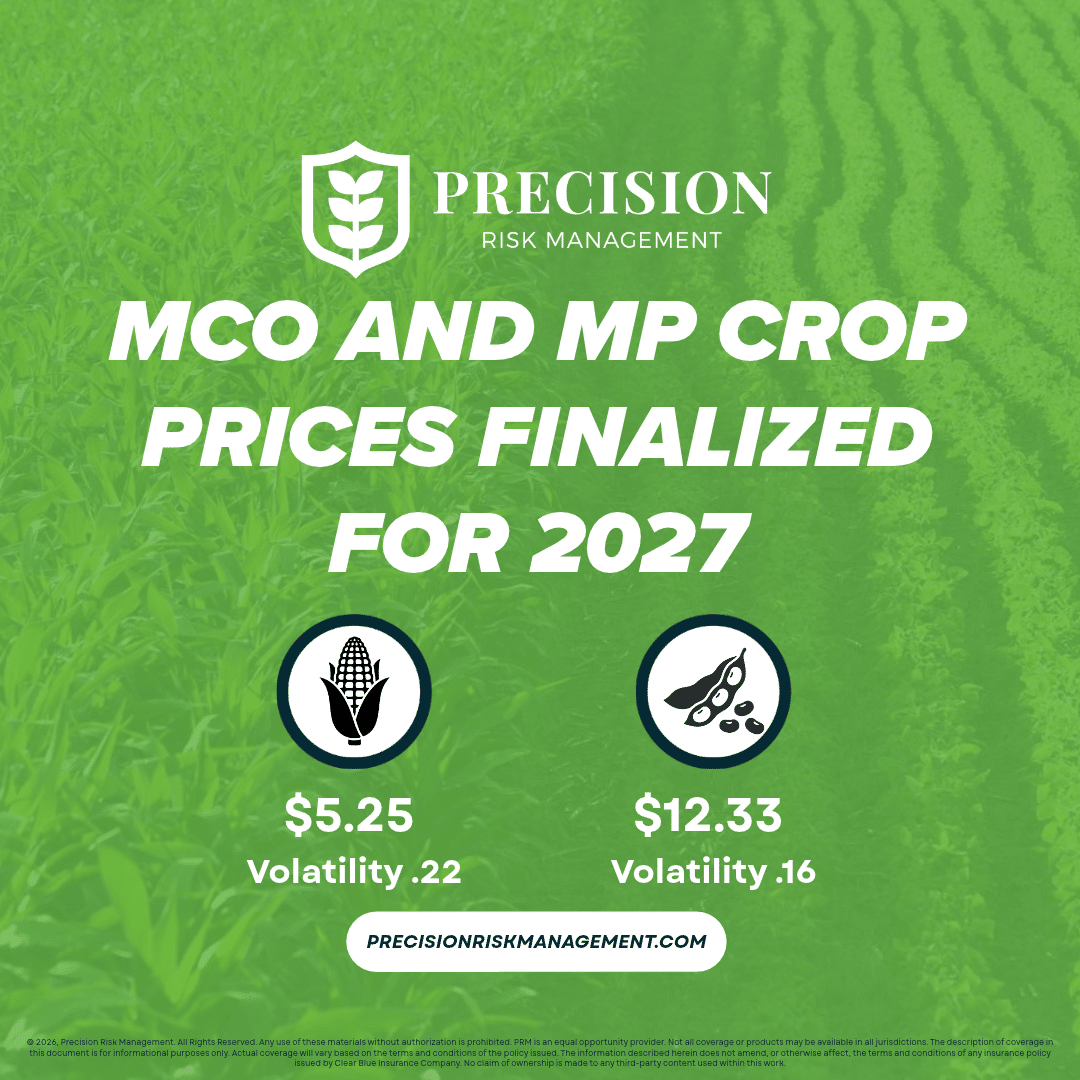
Compared to 2025, volatility factors have dropped. These volatility factors play a significant role in determining premium cost. Plus, corn and spring wheat’s projected prices have dropped. Last year’s projected prices were $4.70 for corn, $10.54 for soybeans, and $6.55 for spring wheat. The lower prices and volatility this year translate directly into lower premium costs for producers.
How These Prices Affect Your Coverage
For farmers carrying Revenue Protection (RP), these projected prices are the baseline for your revenue guarantee. Your coverage is calculated as:

For example, if you have a 200-bushel APH on corn and elected 80% coverage, your revenue guarantee per acre would be:
$4.62 x 200 bu × 80% = $739.20 per acre.
This is the minimum revenue you’re insured for, unless the Harvest Price ends up higher.
For Yield Protection (YP), your guarantee is based strictly on production. If a covered peril drops your bushels, you’ll be paid based on these projected prices for lost bushels.
What About Harvest Prices?
While the Projected Prices set the baseline for your coverage, the Harvest Price adjusts your revenue guarantee if market conditions change. These are set in October for corn and soybeans.
If Harvest Prices are higher than the Projected Price, RP policies will increase your guarantee to match. If Harvest Prices are lower, your original revenue guarantee doesn’t change, and you’re still protected at the higher February projection.
2026 Premiums: One of the Most Affordable Years
This year, producers are benefiting from a combination of factors that are driving premium costs down significantly. There are five main reasons why crop insurance is more affordable in 2025:
- Lower Projected Prices – Prices for corn and spring wheat have dropped from 2025 levels, directly reducing the cost of coverage.
- Lower Volatility – Reduced market volatility lowers the cost of premiums.
- Basic, Optional, and Enterprise Unit Subsidies Increased 3–5% – Thanks to changes in the One Big Beautiful Bill, the government’s share of your premium has increased.
- ECO Subsidy Rates Increased to 80% – Enhanced Coverage Option is now significantly more affordable for producers who want coverage above 86%.
- SCO Subsidy Rates Increased to 80% – Supplemental Coverage Option has also seen a major subsidy boost.
The combined effect of lower commodity prices and increased premium support means that producers can incorporate higher coverage levels into their risk management strategy at a lesser cost than in prior years. To put this in perspective, take a look at the following quote example.
Quote Example: Beadle County, SD
The example below illustrates premium changes for a Beadle County, SD operation with a 161-bushel corn APH and a 46.3-bushel soybean APH.
The first two rows show the impact of lower projected prices and volatility alone. The third row incorporates the premium support increases from the One Big Beautiful Bill, showing the full picture of how much affordable and comprehensive risk management can be for producers.

As you can see, the savings allow the producer the ability to look at additional options. For corn, the RP 75% premium drops from $21.66 per acre in 2025 to just $14.86 with the subsidy increase. That’s a 32% reduction. ECO coverage on corn falls from $13.50 to $7.10, nearly cut in half.
For soybeans, ECO drops from $7.53 to $4.47, a 41% reduction. These are meaningful savings that make it possible for producers to carry higher levels of protection without significantly increasing their cost of production.
Now Is the Time to Review Your Coverage
With premiums at these levels, 2026 presents a unique opportunity to lock in top-end coverage at a lower cost. Whether you’re considering increasing your coverage level, adding ECO/SCO to your policy, or want to understand how these changes affect your operation, PRM’s team is here to help.
At Precision Risk Management, we take a team-based approach. PRM uses precision data and advanced risk analysis to help you maximize your coverage. Our licensed Risk Management Advisors work alongside you to tailor a strategy that fits your farm’s unique needs.
With the March 15th sales closing deadline approaching, now is the time to act. Contact your PRM Risk Management Advisor or call our office today to review your 2026 crop insurance options.
New to PRM and want a personalized quote? Request a quote today!
Quote example is for illustration purposes only. Each operation will have its own factors that determine crop insurance coverage costs. See a licensed Risk Management Advisor for a specific quote. Not all coverage or products may be available in all jurisdictions. The description of coverage in this document is for informational purposes only. Actual coverage will vary based on the terms and conditions of the policy issued. The information described herein does not amend, or otherwise affect, the terms and conditions of any insurance policy issued by Clear Blue Insurance Company.