 |
|---|
By Mike Lessiter, President, Lessiter Media
Brookfield, Wi — Is someone who says they are not a Luddite automatically a Luddite?
Believe me, I am not. Even as a guy who makes his living off of credible, personally crafted and tested information (and the investment it takes to get those insights right), I’m not anti-artificial intelligence (AI), at least for the applications I can comprehend thus far.
In fact, I can “buy” the argument made by Wall Street Journal letterwriter Steve Erdington of Oakland, Calif. On Feb. 21, 2026, he summarized Adam Smith’s point (from his famed 1776 text, The Wealth of Nations) that prosperity follows efficient production. “At its core, AI is an efficiency engine,” writes Erdington. “Economies grow because we improve processes, not because we preserve inefficiencies.”
AI is here and going to change the world we live in; assuming there’s enough energy and water capacity going to keep these behemoth data center operations powered.
But progress also doesn’t arrive free of societal costs in land and water usage. These farmland sales will be wildly profitable for a few outright owners but consider the neighboring farm who need access to rented land to survive. And the ecosystem that supports every activity on those farms.
It is time to wake up and give some thought to the how and where of AI data centers, and what’s left for us in agriculture.
Disappearing Farm Rents is Serious
Just this week, I heard of a progressive Holstein operation here in Wisconsin that wants to put in another brand-new robotic milking facility (nearly doubling its herd). But it must first find confidence that there’ll be enough local grain-production capacity to confidently keep the animals fed, healthy and productive.
The family is ready to greenlight the facility and the capital equipment spending that’ll naturally follow in the additional production to grow, cut and chop, but they’re concerned about the land.
According to the American Farmland Trust, we’re losing 2,000 acres of farmland each day to non-ag uses with a 75 million acres loss from 1997-2022, says USDA. At a time when 39% of all U.S. farmland is rented, every acre of fertile farmland lost has a cost that most aren’t comprehending – even, I’m afraid, within by ag economy stakeholders. Most working farmers won’t find the economies of scale needed on their “own” acres; they need access to more land to shoulder the full breadth of their investments.
The diluted landownership passed to city-dwelling heirs means more generations are further removed from life on the farm. That trend is already unkind to the needs of farmers, including a seeming lack of interest in how their forebearers’ land is stewarded.
Soils Lost to Carpetbaggers
Here in Southeastern Wisconsin, comedian Charlie Berens has used his Manitowoc Minute platform to attack the Vantage Data Centers project in Port Washington, a town of 6,500 a half-hour north of Milwaukee. Among other negative impacts, says Berens, are the cooling water and electricity requirements of the 3.2 million square foot campus to occupy on 1,600 acres.
The data center paid $70,000 per acre, by the way – essentially for “fill.” And I can personally attest that it’s desirable farmland for dairymen and the nearby corn supply needed to keep the cows fed.
It’s going to be too little too late for Port Washington, but Berens has stirred things up, including exposing politicians for falsehoods about farming as they attempt to “keep their project sold.” The mayor has resorted to fearmongering and data centers’ advantages over so-called “factory farms,” which he apparently believes exist solely to recreationally pollute lands that their families have called home for generations.
Data Centers & Farmland Crisis
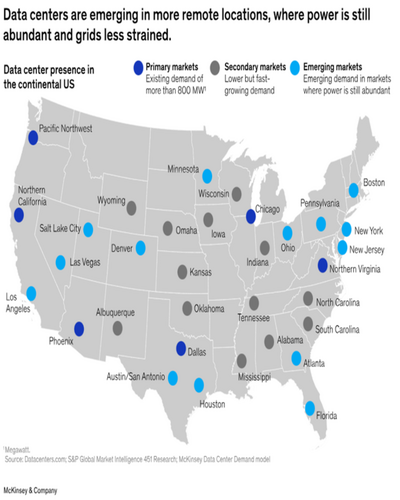
McKinsey reports that data center power demand in the U.S. will jump 3 times between 2023 and 2030. It also notes that “Data centers need a lot of water, which can place stress on local water supplies. A recent report from WestWater Research forecasts that data-center-related water consumption in the U.S. is likely to increase by 170% by 2030.”
This means large footprints of land with lots of access to water. Desperation from farmers examining their financial statements means a perfect intersection of opportunistic buying for AI businesses.
If the geographies competing with ag lands for today’s data centers don’t concern you, consider the “secondary markets” that could be enveloping ag and water supplies in the key ag and breadbasket states. (See the McKinsey graphic below.)
The Wall Street Journal has been reporting on data centers and the “wild west.” Some rural Virginia lands that once sold for tens of thousands of dollars an acre can now sell for over $3 million. In Prince William County, Va., data center developers are offering landowners as much as $1 million an acre. In Northeast Texas, land that normally sold for $20,000-40,000 an acre has jumped to $350,000.
That’s capitalism, I suppose, and there are winners and losers. But when there’s little attention paid to industrial-use zonings, fast-tracked permitting, closed-door municipal boardrooms and government financing and a host of other incentives, it’s time for a timeout.
And there’s more to be concerned about.
As these behemoth facilities go up, every resource imaginable is going to be strained, including rare earths to steel to copper to the skilled labor to build and operate at every phase of development. Think your labor situation is trying now? The likes of the Amazon AI ramp-ups are going to consume more resources – and workforce – than some small businesses would typically see in their lifetime. That’s a threat to small enterprises everywhere.
In some states, entire housing plans are being scrapped to make room for data center money. That means fewer houses and further compounding the problems with housing affordability.
And as it comes your way, you’ll feel the impacts as well. Younger talent who want to come to rural American are already feeling priced out of their share of the American dream. That means one more obstacle for your future workforce, too.
The politicians and money folks all talk about citizens getting tax relief from these big paydays. Like most things of this ilk, believe it when you see it.
Local Observations
We’re sensitive to soil resources around these parts. My dad, Frank (founding editor of No-Till Farmer in 1972), reported on the farmers in Kentucky and Tennessee who tearfully watched their soils wash away in the early 1970s. They knew the bare sands hidden just inches below their feet would not allow a continued livelihood if changes weren’t made.
Luckily, they were able to turn to the then-experimental practice of direct seeding (no-till). They embraced it because they had to do something to protect what was left of their soil and found other economic benefits along the way too.
A single inch of soil takes half a millennium or more to create. Thus, we can’t afford to be cavalier about letting good and fertile farmland slip away for uses – like data centers – that could land in myriad other places.
Second, I reported on heavy industry for 12 years (think scap and molten metals, spent foundry sands and binders) and may know a thing or two about the now-shuttered factories that operated in a different era. Those sites – often eyesores for their neighbors — await a renaissance while we instead see productive soils destroyed.
And third, I’m here in Wisconsin, just 40 miles from the Case IH headquarters in Racine County. This cautionary tale described below isn’t AI or data centers in this instance, but rather that of a rich government package to lure LCD screen production in 2017.
With the promise of a 20-million square foot campus, Foxconn was lured to Wisconsin with a $3 billion-plus incentive package. About 1,200 acres were bought up at $50,000 per acre from dozens of landowners and farmers. Keep in mind that these per-acre numbers were back in 2017…
There was a promise to bring a $10 billion investment with 13,000 jobs, with the cost of the government incentives estimated at $172,000 to $290,000. Yes, that’s per job, and only if the ship fully comes in.
Five years later, it brought only 1,200 W-2s and the incentives had to be redrawn down to a mere $80 million (from nearly $3 billion). I guess some of the egg on the face was dabbed away by Microsoft purchasing a 315-acre plot for its own data center.
My governor was behind the widely celebrated deal. I was uneasy over it, but not for the pile of debt and infrastructure sunk by optimistic governments. I worried over unsustainable wage wars.
By the way, there are some 40 U.S. states pitching tax incentives to lure data centers, including Virginia and Texas, who are offering $1 billion in tax exemptions as well as Indiana and its 50-year sales tax exemption pitches. Alabama, Georgia, North Carolina and Iowa also are known for pitching aggressive incentives.
Chances are, deals are being made right now to swap out productive farmland for software companies in your own AOR.
3 Solutions
If you’ve seen the Landman, you might appreciate the approach of Tommy Norris (Billy Bob Thornton) to challenges. “I don’t talk about the problem until I have a solution,” he says. “Then, I’ll discuss the solution with you and determine if the problem is solved.”
So, in that spirit of Tommy the problem-solving energy executive, here’s a few things to suggest to those in charge…
1. Require Brownfield Sites Instead — Most of you know about brownfield sites; those properties where redevelopment is complicated by the presence or potential presence of pollutants or contaminants from production of years gone by. Generally, they are industrial properties that sit idle due to environmental challenges to fix before reuse.
There are a half-million sites comprising 5 million acres of land that could be returned to a beneficial use – like a data center. If government resources are gonna get tossed about, then use them for that.
Take for instance the 4.8 million square foot eyesore left in Janesville, Wis., home to GM’s Assembly Plant until its closure 17 years ago. “Two-hundred forty acres with falling down fences, with holes in the ground, where you’ve got sinkholes, where you’ve got so much that is compromised,” said Janesville Economic Director Jimsi Kuborn in 2024. A negative impact right in the middle of the city is how Kuborn referred to it.
And as for the race for shovel-ready construction the software companies desire, maybe it’s best to slow things down anyway. We don’t need yet another example of how the destination gets inquired about only after the train leaves the station.
2. Yes, Convert Housing If Needed — It wouldn’t register as most folks’ first choice, but clearing out tired, crowded or undesirable housing is a better option than removing rich soils from crop production. In suburban Chicago (don’t get me started on the state of Illinois), Stream Data Center purchased a 55-home subdivision — at nearly $1 million per home — to put up 2.1 million square feet of data centers.
3. What About ‘Marginal’ Cropland? – Few would argue there’s a great deal of land being farmed that’s unsuitable for productive use, especially with worries about water levels and skyrocketing input costs. Still this use is more attractive that tossing aside some of the best soils on the planet – for nothing more than a structure in which to sink construction piles.
Meet Merv Raudebaugh
You might have heard this week about 86-year-old Pennsylvania farmer Mervin Raudabaugh, who turned down a data center developer’s offer of $60,000 ($15 million in total) and instead sold his farms to the township at a fraction of that price – to preserve the land for agricultural use in perpetuity.
I’m guessing Mervin concluded that his ancestors didn’t meaninglessly harness the soils only to make a quick buck on space-age use, or lend its water table to cool down humming computers.
My great-great grandfather (John Lessiter) left England in 1847 to pursue a way of life and control his own destiny in the new western world. In 1990, my octogenarian grandfather (also named John), sold his Michigan centennial farm when neither my dad (4 states away) nor my aunt weren’t viable prospects to buy the land, which by then was very much in the middle of suburbia.
Things didn’t go as planned for Grandpa and his buyer either, though I know he’s smiling down today at the young couple who bought and preserved the original 1854 farmhouse and 1905-built barn.
But considering his dismay upon watching the house he built and wired with his own hands in 1938 scraped away, I have an idea what the retired farmer and township supervisor might’ve had to say if an AI data center had come calling. I don’t believe he ever did anything “just for the greenbacks” it might’ve brought him.
Land loss, water wars and distant landlords who no longer greet their neighbors in town anymore … There is lot at stake, including for those throughout the ecosystem, who haven’t yet articulated the right questions to ask. Hopefully, we’ll consider what it is we want and who can be trusted in the communities we work and live.