
 |
|---|
by Chad Hart and Ann M. Johanns, Iowa State Extension
Ames, IA — Iowa producers continue to face a challenging cost and revenue environment as they transition from the 2025 crop year into planning for 2026. The economic outlook for 2026 continues the pattern from the last two years, with average prices below production costs. Opportunities for profits will be limited this year.
Iowa State University Extension and Outreach’s publication Estimated Costs of Crop Production in Iowa provides updated benchmarks, allowing producers to assess cost trends and refine their own projections.
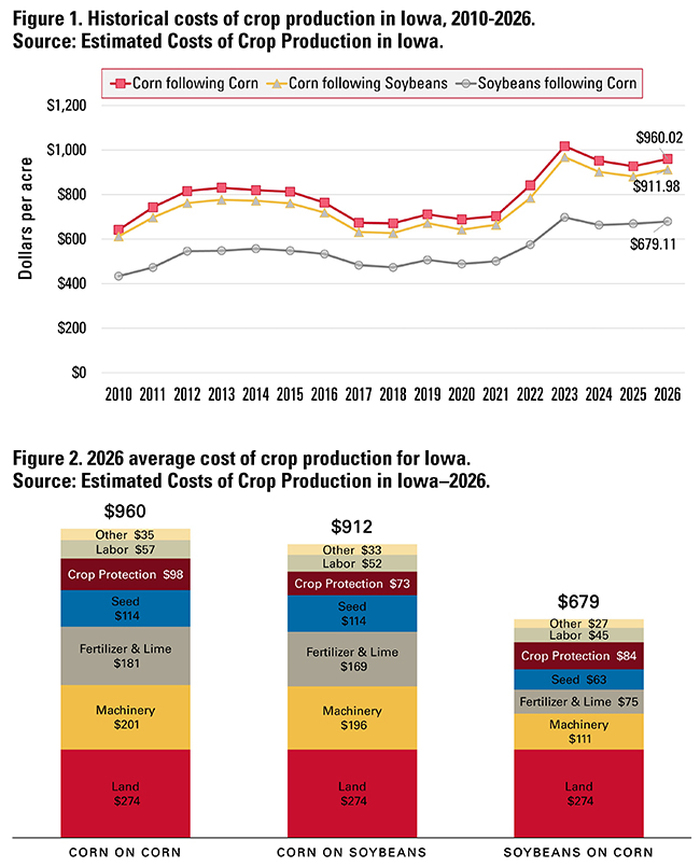
The 2026 report shows a 4% increase in the cost of corn production, driven mainly by higher fertilizer and chemical costs compared to 2025, whereas soybean costs are 2% higher (Figure 1). Total cost per bushel is impacted by higher trend yields used in the budgets, with the additional bushels mitigating some of the cost increases. Land cost is projected to be slightly lower, with increases in labor and machinery costs, of 1% and 3-4% respectively.
The crop budgets are built using data from multiple sources, including Iowa Farm Business Association records, Iowa State University research, and surveys of agricultural input suppliers. Costs include seed, fertilizer, chemicals, fuel, repairs, labor, machinery ownership, crop insurance, interest on operating capital, and land (valued at a projected cash rent equivalent). The budgets reflect costs of production only and do not include storage costs, returns to management, or profit margins.
The Estimated Costs of Crop Production budgets represent statewide average costs for farms in Iowa and should be used as planning benchmarks rather than exact estimates for individual farms.
Farm level variability matters more than averages. Actual costs can differ substantially from published budgets due to soil productivity, machinery strategies, land tenure, and management choices.
Labor is treated as a fixed cost in the report, because most labor on Iowa farms is supplied by the operator, family, or permanent hired labor.Additional crop budgets and resources
In addition to corn and soybeans, the Ag Decision Maker publication includes budgets for corn silage, alfalfa hay, and pasture maintenance, as well as alternative production systems such as strip till and reduced tillage corn and soybean operations. These budgets allow producers to evaluate rotation changes or forage options within a whole farm context.
Producers are strongly encouraged to use the interactive spreadsheet budgets and web based calculators available through the Ag Decision Maker website. These tools allow users to:
*Enter farm specific input prices,
*Adjust yields based on historical performance,
*Modify machinery and labor assumptions, and
*Evaluate alternative land cost scenarios.
By customizing these budgets, producers can move beyond statewide averages and develop more accurate estimates of their own 2026 production costs, which is essential for marketing, cash flow planning, and discussions with lenders.
Looking ahead
The comparison of 2025 and 2026 estimated costs of crop production underscores a transition from rapidly changing input prices to a period of persistent, structurally higher production costs. While cost volatility may be lower than in recent years, the margin pressure facing Iowa corn and soybean producers remains significant. Accurate cost tracking, realistic yield expectations, and use of farm specific budgeting tools will be critical as producers plan for the 2026 crop year and beyond.
For full budget tables, spreadsheets, and decision tools, producers should consult the Estimated Costs of Crop Production in Iowa publications and related resources available through Iowa State University Extension and Outreach’s Ag Decision Maker program. Historical average estimates of Iowa crop production costs are also available.
