 |
|---|
Source: Research Intelo
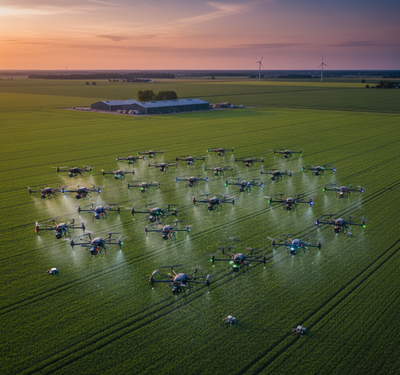
According to Research Intelo, the Global Precision Agriculture Drone Swarm market size was valued at $1.2 billion in 2024 and is projected to reach $7.8 billion by 2033, expanding at a robust CAGR of 23.7% during 2024-2033. This remarkable growth trajectory is primarily driven by the increasing need for high-efficiency, data-driven farming practices that address global food security challenges and optimize resource utilization. The integration of advanced drone swarms in precision agriculture is revolutionizing field operations, enabling simultaneous multi-drone deployments for tasks such as crop monitoring, spraying, and mapping, thus significantly improving productivity and reducing operational costs for farmers and agribusinesses worldwide.
The Precision Agriculture Drone Swarm Market is emerging as one of the most disruptive segments in the AgriTech ecosystem, blending robotics, artificial intelligence, and advanced sensing technologies to optimize farm operations. Unlike standalone agricultural drones that operate individually, drone swarms function as coordinated fleets capable of executing tasks simultaneously across large landscapes. This shift from single-unit automation to multi-agent collaboration is reshaping the scalability, precision, and economics of modern farming. As global agricultural challenges intensify ranging from resource constraints to climate variability the adoption of drone swarms is rapidly accelerating across commercial farms, research institutions, and agri-business service providers.
Key Market Drivers
Intensifying Need for Data-Driven Farming
Modern agriculture now demands high-resolution, real-time field insights to enhance productivity and reduce losses. Drone swarms, equipped with thermal, LiDAR, hyperspectral, and RGB sensors, provide continuous data streams that enable farmers to monitor crop stress, pest infestation, nutrient deficiencies, and soil moisture variability with extreme accuracy.
Labor Shortages and Increasing Operational Efficiency
Agricultural labor shortages are compelling farmers to adopt autonomous technologies. Drone swarms significantly reduce manual fieldwork by performing tasks such as spraying, scouting, and mapping in a fraction of the time. Their synchronized flight patterns enable simultaneous coverage of multiple fields, lowering operational costs and increasing productivity.
Climate Change and Sustainable Farming
Changing climate patterns have increased the frequency of plant diseases, droughts, and pest outbreaks. Drone swarms help farmers respond proactively by offering predictive analytics and early detection. Furthermore, swarm-based spraying minimizes chemical use by precisely targeting affected zones, supporting sustainability and environmental compliance.
Technological Advancements in Swarm AI
Breakthroughs in swarm intelligence, communication protocols, and collision-avoidance systems are enabling safer and more autonomous drone operations. These advancements reduce human intervention and open new possibilities for complex tasks like coordinated soil mapping, distributed seed spraying, and plant-level monitoring.
Challenges and Opportunities
Challenges
• Regulatory limitations for multi-drone operations
• High initial investment costs
• Flight safety concerns and communication interference risks
• Need for skilled operators and data analysts
Opportunities
• Growth of autonomous farm ecosystems
• Expansion of swarm robotics into livestock monitoring
• Development of 5G-enabled command systems
• Integration with IoT devices, satellite imagery, and digital twins
Future Outlook
The Precision Agriculture Drone Swarm Market is poised for exponential growth as farms adopt digital transformation and autonomous field operations. Advances in distributed AI, onboard computing, and energy efficiency will make swarms more intelligent, robust, and economically accessible. In the coming decade, coordinated drone fleets will play a central role in enabling climate-smart agriculture, optimizing resource usage, and boosting global food production sustainably.
Competitive Landscape
Prominent companies operating in the market are:
• DJI
• Yamaha Motor Company
• Parrot SA
• PrecisionHawk
• AeroVironment
• AgEagle Aerial Systems
• Delair
• senseFly
• Trimble Inc.
• DroneDeploy
• Raven Industries
• Hylio
• XAG Co., Ltd.
Source: https://researchintelo.com/report/precision-agriculture-drone-swarm-market